
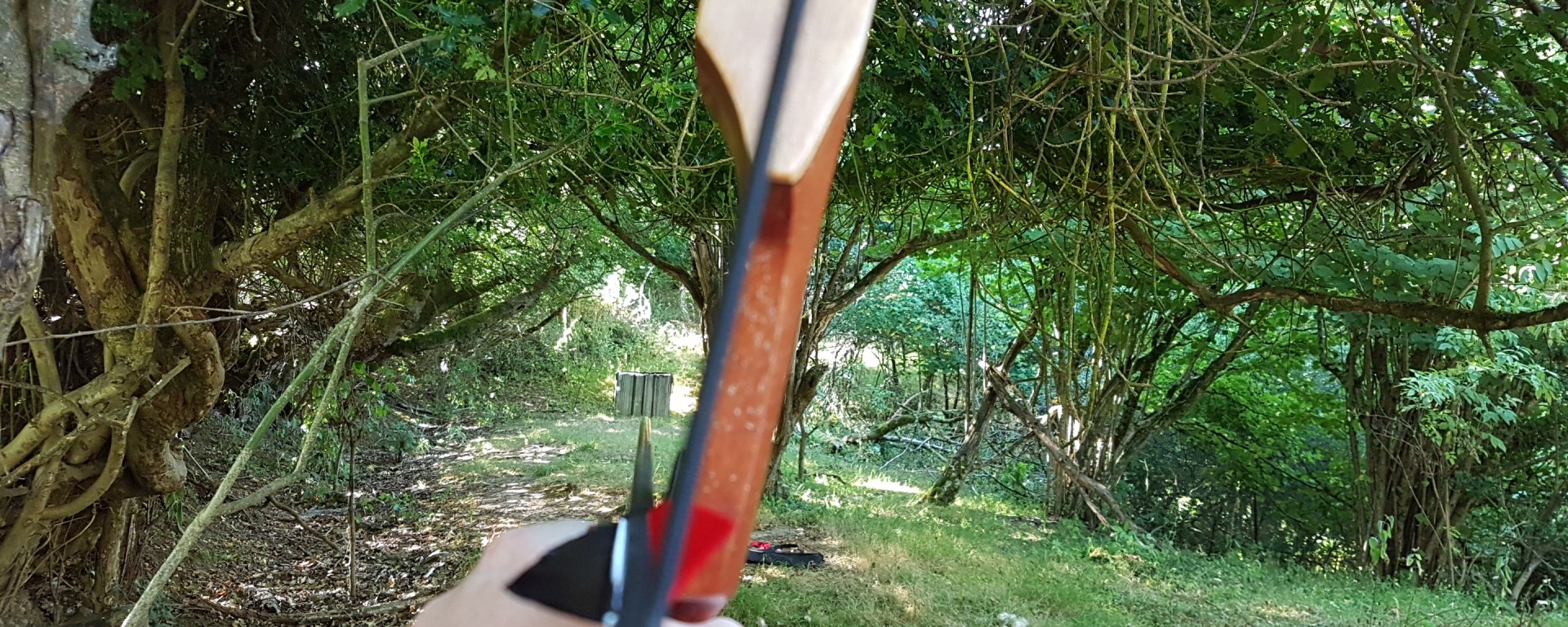
To “cant” (which rhymes with “ant”) your bow is the act of deliberately tilting it at a slight sideways angle when shooting, instead of keeping it completely vertical.
Whether to cant your bow or keep it vertical is one of the most hotly debated topics in archery. I have witnessed otherwise normally placid individuals become irked by the very discussion.
Compound bow shooters who choose to use sights, stabilisers and so on will usually keep their bow absolutely vertical to make best use of their devices.
However for traditional barebow, American flatbow (AFB) and horsebow a slight canting of the bow is often preferred. Based on my own observations of archers, I would say slightly more people cant their bow than not.
Previously well-respected archers in your eyes may suddenly seem utterly mad when you discover their opinions on this topic. Like discovering your best mate is a Flat-Earther. So… are you a canter or not? Either way – WHY? Damn you and your fevered mind! We delve into the topic here. Whichever way you choose – you’re right and it’s that other lot who are mental! Ding-ding, round one….
Team A – Confirmed Cants
Some archers will always cant their bow for several reasons.
It puts your eye over the arrow
The most important reason for me is that by canting the bow, it is easier to get your dominant eye directly above the arrow.
If the bow is held perfectly vertical, then depending on your face shape and anchor point, the string will press uncomfortably into the side of your face, and may prevent you from being able to easily look directly down the arrow shaft.
Looking straight down the arrow is probably the most important step in setting your arrow’s left-right aim accurately, and consistently.
By placing the pupil of your eye exactly above the arrow shaft, so you are looking straight down the full length, the left-right position of the arrow is predictable (assuming that your arrow spine is matched with your bow of course).
This is also very important to allow for different head shapes. People with chunky head shapes (like me) will need to cant the bow at a steeper angle to position their eye directly above the arrow, as a totally vertical string can press into some face shapes.
Put a cross on a decent target, and experiment with different cant angles. You will notice your arrow hits left – right in relation to the angle of your cant.
It opens the sight window
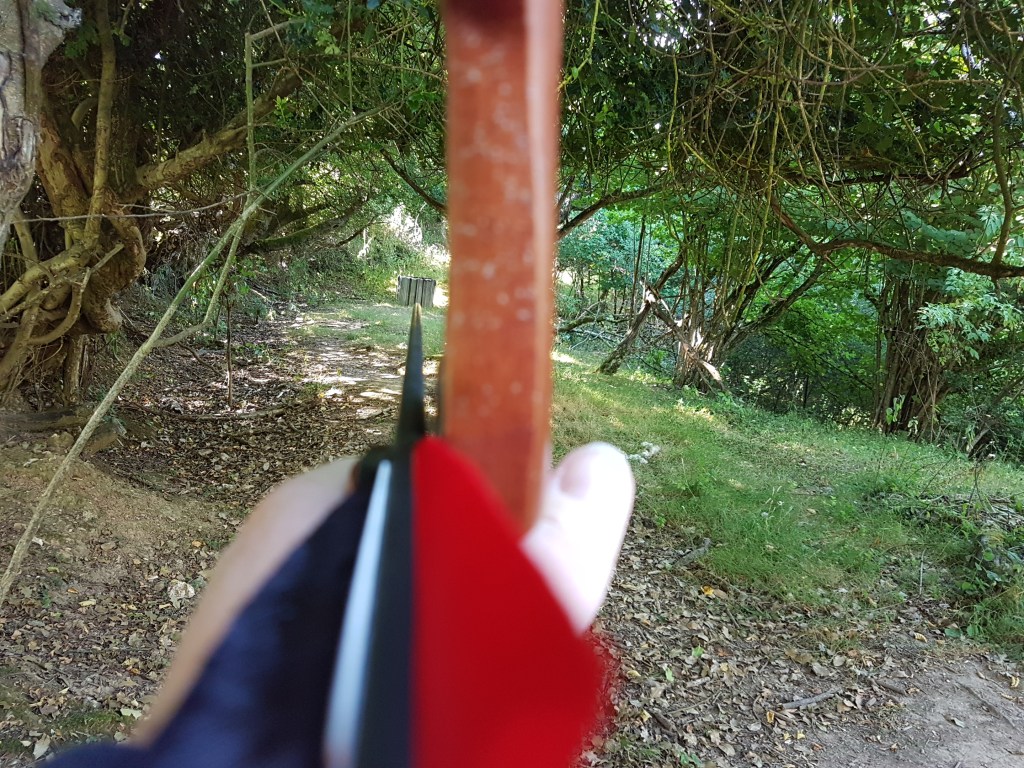
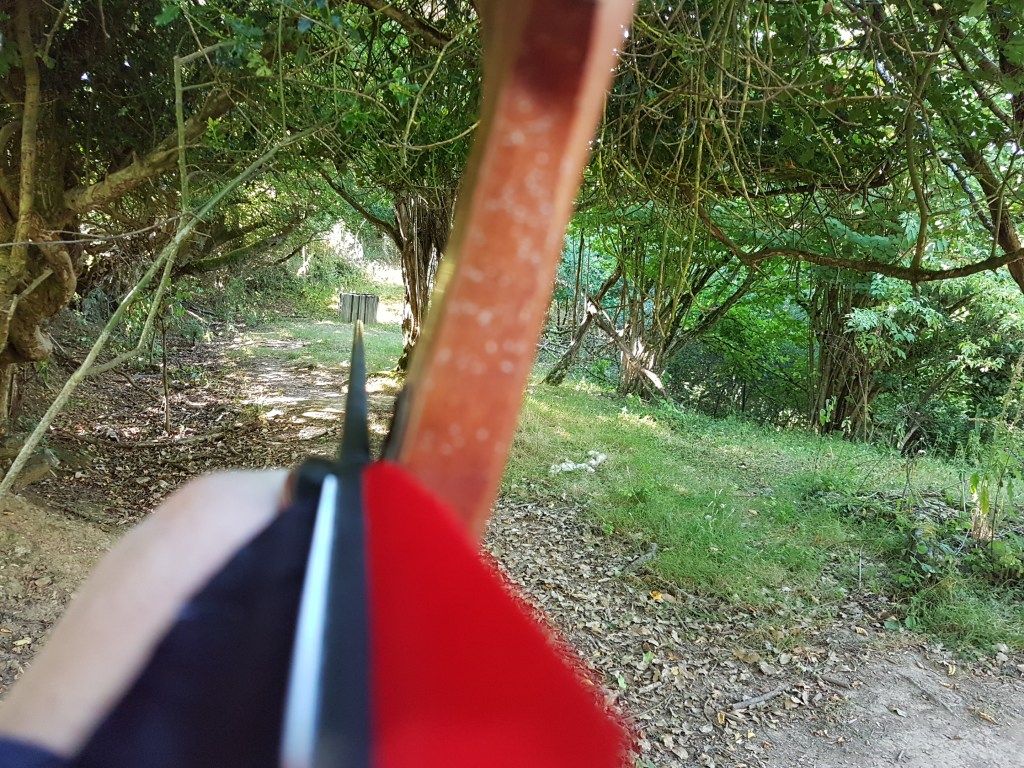
When you cant the bow, you widen your sight window, and can see the target much better.
Without canting the bow, you will see less of the target, because your dominant eye’s vision is basically blocked by the bow in front of you.
As soon as you cant to the correct angle (correct for you), it moves the bow out of the way of your dominant eye so you can see in front of the bow clearly.
In field archery this is extra helpful, as you need to see more of the rough terrain and broken ground to accurately judge the distance.
If you shoot with both eyes open, or with a centre-cut bow this is less of an issue, but personally I feel it is best to give your over-arrow eye maximum view of the target and terrain.
Easier to stop the arrow falling off some bows
If you shoot directly off the shelf, you may find the arrow can slip off the side when holding the bow vertically, if you are not careful or if on the move. This is not only embarrassing, it can also be dangerous, and someone may step on your arrow (probably yourself). By canting the bow, it creates a nice groove for the arrow to sit.
Shooting off the shelf puts the arrow closer to the bow-hand too, and thus the pivot point. When shooting off the shelf, the angle of cant is more forgiving than if using a bow with an elevated arrow rest.
Team B – Not Fans Of Cant
Many archers favour keeping their bow totally vertical when shooting.
It can be more consistent
Non-canters say it is easier to find a consistent angle if you always set your bow vertically. A vertical angle is something we can all judge easily, but I feel every individual’s style of shooting becomes muscle memory and “your shot” after a relatively short time.
Your skill in finding a vertical line also relates to the angle you are looking at if from, and so by angling your head to look straight down the arrow shaft, your vertical sense may be skewed.
Canting may induce string torque
If your anchor point is very high up on your face, like at the top of your cheek bone for example, then canting may unevenly twist the string against your face and create a bad release. Personally I anchor at the edge of my lip, and my face shape is such that a cant doesn’t cause me any problems on release, but depending on your face shape and anchor point this could be a consideration.
Sights and elevated rests work better vertically
If using a sight or arrow rest higher than your hand, they are designed to work better when the bow is held vertically. Your bow-hand is the pivot point, so anything above this pivot point will go out of alignment when canting the bow. Not such a consideration for barebow shelf-shooters.
To Cant Or Not To Cant?
As you can see, it really depends on several factors.
It’s absolutely worth trying both approaches, even if you have been shooting only one way for years. Always a good experiment to try something different, even if it only reinforces in your mind that you were correct all along!
Some archers switch methods depending which style of bow they are using. This makes sense as if you have a modern recurve bow with a wide sight window on your bow then you don’t NEED to cant. However if you have a more traditional bow with a straighter edge, you will probably find it useful. If you switch between bows, you may find you are more consistent by alwa
I’ve even heard of archers using different cant angles for different distances. Personally I can’t see how this would benefit at all, as archery is about repeatability and changing angle for distance seems to complicate the variables, when you would normally only need to aim higher for longer distances.
Personally, I find the benefits of canting outweigh the negatives, and mostly I prefer the wider sight window. But your mileage may differ.
You can’t just guess the cant – test the cant!
To find your ideal cant angle, set a cross pattern on your target. Take shots from vertical, slightly canting the bow each time and noting the angle. You will soon find an angle that feels right, and will notice your shots strafe the horizontal line across your target. When you consistently hit the vertical, that’s your angle.
I find it fun to have a physical vertical line, like a weighted string, or a bamboo cane stuck into the ground for example. When you hit it, it gives that little extra satisfaction.
Happy shooting!
Please Subscribe To Our Mailing List
For new articles direct to your inbox! http://eepurl.com/gVlnq1 Easy unsubscribe any time.
 Field Archery Magazine